


Fire, Empire, and the Afterlife of Colonial Urbanism in Hong Kong
Sophia Halib
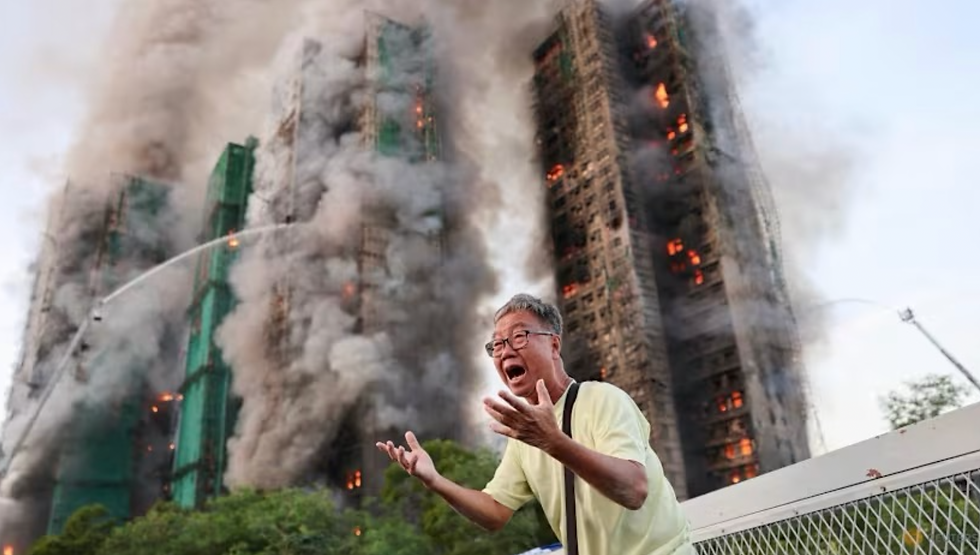
2:51 p.m. Wang Cheng House, Wang Fuk Court, Tai Po District.
A building was still under renovation when the fire broke out. Within minutes, flames surged upward, leaping across scaffolding and engulfing neighbouring blocks. Wang Tai House. Wang Shing House.
By the time the fire was brought under control, 83 people were dead. Another 279 were missing.
When recent fires tore through residential buildings in Hong Kong, on November 26th, the images felt hauntingly familiar…Smoke climbing the facades of overcrowded high-rises, residents fleeing down narrow stairwells, emergency crews struggling against conditions long known to be dangerous, the scenes echoed the 2017 Grenfell Tower fire in London. Similarly, the quick fire spread has early explanations quickly became those of technical factors.
In Hong Kong, bamboo scaffolding became the primary suspect, framed as an unfortunate but isolated accelerant in an otherwise unfortunate accident, where an “unfortunate” amount of people were affected.
Yet to treat these fires as accidents is to perhaps misunderstand them. What burned in Hong Kong was bamboo but also the long afterlife flame of a colonial urban system, one designed for other primary reasons other than citizen’s protection. This article suggests that, seen through a postcolonial lens, conditions that allowed the fires to spread were a result of a city built under British rule and still preserved, despite the evident potential failures, still after 1997.
Fire as a Political Event
Fires in dense cities are rarely “natural disasters.” The immediate explanations are bamboo scaffolding, outdated wiring, or poor maintenance, functioning as feasible technical distractions. They locate responsibility in materials rather than in the systems that determine why those materials persist in the first place. Bamboo scaffolding did not appear spontaneously; it remains used until this day because of historic regulatory choices.
Bamboo scaffolding has been used in southern China for over a thousand years. It is lightweight, renewable, adaptable, and when properly maintained, remarkably strong. When the British arrived in Hong Kong in the 19th century, they did not replace these old construction practices with their European ones. Instead, they selectively retained what was cheapest and most convenient.
Steel scaffolding required importation, standardisation, inspection, and skilled labour. Bamboo did not. It was abundant, cheap, and labour-intensive, ideal for a colonial economy built on expendable labour and minimal regulation.
By the early twentieth century, bamboo scaffolding had become institutionalised. British authorities codified its use because it was economical and compatible with rapid urban expansion. This approach aligned with a broader colonial logic: invest minimally, extract maximally.
Density by design
Colonial Hong Kong was never designed as a livable city for its population. It was designed as a port, a commercial outpost facilitating imperial trade and capital circulation. From the beginning, urban planning prioritised efficiency, profit, and control rather than Hongkonese welfare.
The British colonial government introduced a land regime in which all land was state-owned and leased at high prices. This artificial scarcity generated enormous revenue while forcing density upward. Housing became a commodity rather than a social good. The consequences are visible today: some of the world’s most expensive real estate, extreme vertical living, subdivided flats, and aging building stock concentrated in working-class districts such as Sham Shui Po, Yau Ma Tei, and Tai Po.
From the 1960s onward, British colonial authorities increasingly relied on a small circle of powerful developers to manage urban growth. This alliance consolidated immense political and economic power in private hands, embedding a model in which the state facilitated accumulation rather than regulation.
That arrangement has never truly been dismantled. Even after 1997, Hong Kong’s political economy remained structurally intact. The same developers dominate land supply. The same incentives privilege redevelopment for profit over public safety. The same reluctance to interfere with the market constrains regulatory reform.
As geographer David Harvey has argued, urbanisation under capitalism functions as a mechanism for absorbing surplus capital, often at the expense of social reproduction. In this sense, disasters like the Hong Kong fires are a sign of system failures and expressions of how the system works. Risk is displaced onto those with the least political power, while value continues to be extracted upward.
Late Colonialism and the Persistence of Risk
To understand why these conditions persist, it is useful to turn to the concept of late colonialism, articulated by scholars such as Gregory B. Lee and Patrick Poon. Hong Kong, they argue, was never decolonised in a transformative sense. Instead, colonial governance structures were preserved and repurposed after 1997.
Political participation had long been limited under British rule, and this absence of democratic accountability was not corrected at the handover. Instead, a highly technocratic, managerial system endured…
There is a shared logic: the treatment of certain lives as expendable in the pursuit of economic order. This logic extends beyond Hong Kong with the British Empire as it is visible in other geographical contexts such as Kashmir or Palestine, where the colonial empire’s administrative systems continue to produce instability and precarity long after formal rule has ended.
To only focus on bamboo scaffolding is to miss the point. What burned before and caused the burning today was a system, one that has long normalised risk for the many while insulating the elite few.
Fire, in this sense, is not an anomaly but a revelation.


